Tag Archive for: public speaking

The Public Speaking Power in Creating

Public Speaking is all about you, isn't it?

You the speaker.

You creating a speech.

You delivering a speech.

You taking the audience on a journey.

You affecting the outcome.

You presenting stories, humour, information, ideas, products.

Me, the speaker.

Me, facing my fears.

Me, being confident.

Me, remembering the best words to use.

Me, creating energy in the room.

Me, finally achieving success as a speaker.

This blog is aimed at You (and if you are reading this, then it is about "me").

I am writing and speaking to you, hoping to give you ideas and resources that will be of value to you as a speaker.

Strange, then, that the one sure foundation of success is the ability, once the presentation begins (or even in the marketing beforehand) to make it about us - all of us in the room, all of us on this journey to being better, living better, being and living more easily.

Not just the audience - the "you" to whom we speak - else we become preachers, philosophers, at least one step, if not a whole staircase removed, from that audience, that "you".

We are all on this journey together, supporting each other.

How can we best ensure that, in our blogs, in our social media, in our speaking?

If your audience cannot hear you, you have lost them.

If there is no microphone, and even if there is, it is your responsibility, in the end, to make sure people can hear you.

1. Project your voice - right to that back row.

2. Articulate well. Practice overdoing it sometimes - hilarious, I know, but a great way to remind you voice muscles that they are expected to work for you and to say words properly without slurring, mumbling, muttering or leaving off the ends of words. In today's fast-paced world we sometimes develop lazy habits.

3. Take the time to pronounce each word properly. Research every word you use so you don't get caught. You may be heard, but it's going to be distracting if you mispronounce something, or stumble over it.

4. Using abbreviations or acronyms? Unless they are in common usage, they might as well have been whispered if someone in your audience has not idea what you mean.

5. You will have made the effort to visit the venue if at all possible before you present. While you are checking it over for all possibilities, remember to check the accoustics, and the microphone.

6. Have someone you can call on to deal with unforeseen issues like a noisy air conditioner, a noisy audience member or a noisy microphone. If there is no someone, have a disaster management plan in place.

7. Don't forget to make your audience very aware that you have their interests at heart, that you are meeting their needs, and that you are all in this together, or they will stop listening anyway.

And, in the end, there is always that old tried and true phrase "lend me your ears" - well --- maybe!


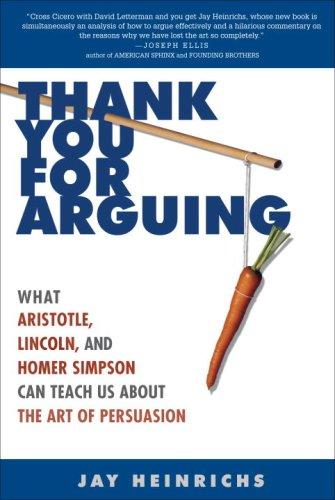
Whether you’re an inveterate lover of language books or just want to win a lot more anger-free arguments on the page, at the podium, or over a beer, Thank You for Arguing is for you ... and I featured it at Pivotal Public Speaking >> here

thank_you_arguing

Thank You for Arguing is your master class in the art of persuasion, taught by professors ranging from Bart Simpson to Winston Churchill.

The time-tested secrets this book discloses include Cicero’s three-step strategy for moving an audience to action—as well as Honest Abe’s Shameless Trick of lowering an audience’s expectations by pretending to be unpolished. But it’s also replete with contemporary techniques such as politicians’ use of “code” language to appeal to specific groups and an eye-opening assortment of popular-culture dodges—including The Yoda Technique, The Belushi Paradigm, and The Eddie Haskell Ploy.

Whether you’re an inveterate lover of language books or just want to win a lot more anger-free arguments on the page, at the podium, or over a beer, Thank You for Arguing is for you. Written by one of today’s most popular language mavens, it’s warm, witty, erudite, and truly enlightening. It not only teaches you how to recognize a paralipsis and a chiasmus when you hear them, but also how to wield such handy and persuasive weapons the next time you really, really want to get your own way.

JAY HEINRICHS spent 25 years as a journalist and publishing executive before becoming a fulltime advocate for the lost art of rhetoric. Since then he's taught persuasion to Fortune 500 companies, Ivy League universities, NASA, and the Pentagon. He is also the author of "Word Hero: A Fiendishly Clever Guide to Crafting the Lines that Get Laughs, Go Viral, and Live Forever."

Buy the book

fishpond_logo
the_nile
amazon_logobook_depository_logo

individuality

"A graduation ceremony is an event where the commencement speaker tells thousands of students dressed in identical caps and gowns that 'individuality' is the key to success."

— Robert Orben

Tweet: To be seen as credible you need to be seen as competent @bronwynr

Your credibility will be built on how your audience perceives your competence, your character and your charisma.

Let's look at that first element of credibility - competence. To be seen as credible you need to be seen as competent.

Obviously you need to know your material, and know it very well. Know it so that you can answer questions that go deep into your subject. Also know your limitations and how you can refer questions to someone who is an expert.

Establish your competence right from the beginning, by ensuring your audience is aware of your credentials and experience. These can be written, very factually into your advertising material, website and brochures. They can also be written into the introduction you are given when you speak. You can also weave them into your speech, and particularly into the introduction. Bragging will not work here. Stories will, however be incredibly effective. Make sure the stories support a point you are making, and it would be good if the point is not necessarily about your competence. Use stories about your experiences, about your client successes and case studies.

Being well organised will show your competence.

Confident presentation will indicate competence. Be prepared for your presentation so that the confidence is genuine. Use eye contact to further establish your confidence and sincerity – your comfort with your subject and the act of sharing your information. Composure – emotional control - is anther facet of this. Be prepared for anything that might throw your emotional control.
Finally, use quotations, statistics and other support material from sources that are held in high regard by your audience. If you are quoting a source on health, for example, you would choose, say, the Mayo Clinic rather than, for example, Wikipedia.

Plant the seeds of your credibility throughout your speech or presentation. Establish your competence, and you will have established a foundation for successfully persuading your audience to act, be or think in the way you wanted.

I was prowling around Youtube this afternoon (as one does on a Sunday when the grey day does not permit any exploration outdoors!!) and found this beautifully lucid, simple and yet strangely powerful way of putting together an elevator pitch. I love it. Next networking meeting, I'm going to try it out ...

"There are two things that are more difficult than making an after-dinner speech: climbing a wall which is leaning toward you and kissing a girl who is leaning away from you."

— Winston Churchill

churchill statue

Ah Mr. Churchill! He created resonance with the audience, knowing that most find speeches difficult, intrigued them with the mention of two things, and used wonderful "rhetoric" with his phrases that repeated structure and image. What a speaker!