8 Secrets from the Internet that can help you go viral as a speaker

What is it that will make you go viral - become admired and rehired as a speaker?

What is it that will have audiences flocking to your presentations where they will engage with you, and change or act or think differently as a result of their experience?

Afterwards, their conversations will be about your presentation; stimulated by the experience, providing positive feedback to you … and to event coordinators!

And if there’s one thing event coordinators love, it’s speakers who come recommended, and with their own fan base.

What makes people tweet your sound bytes? What makes them recommend your presentation and share it? What makes them give that positive feedback?

“I’ve learned that people will forget what you said, people will forget what you did, but people will never forget how you made them feel” ~ Maya Angelou

The answer lies in the viral elements you embed in your presentations. These are the elements that create an experience for your audience, make them feel something, involve them. They catch and keep attention. They heighten the impact. They are then held in the memory, and shared later. They are the elements that make internet content go viral and that you can use to build your own reputation.

Here are 8 specific elements that provide those experiences on the internet - making people want to share, and making others want to click and experience for themselves – that you can use in your speaking to make you and your message “go viral”.

1. Tell a story
People are used to watching stories on screens – in the theatre, on television and computer. A piece of content that tells a story, on the internet, then, automatically captures attention and draws an audience in immediately. They follow along with the story, waiting for the entertainment or the learning that they expect from a story. Your audiences, too, have been hardwired by a long history of storytelling to automatically tune in to a story, giving you instant engagement - in the same way. You then have the opportunity to draw them in with you, into the story, its emotional arc and its “moral”. Make it vivid enough, make it work to communicate a point, and you have created that element, that experience, that feeling; a memory to be valued and shared.

2. Appeal to an emotion
May Angelou’s quote says it all. Emotion on its own is a means for content to go viral, and for you to create an element that people will remember from your presentation. It can by funny (think videos of babies laughing) or sad (family loss or cancer’s ravages), moving or stupid, cute (all those Facebook videos of cute animals) strange or gross. Create an emotion to associate with your message and attract “hits” - attention, and “shares” – recommendations.

3. Add a roller-coaster to the emotion …
and you multiply the effect. You may have seen the Dove “sketches” video. It utilises this effect well, as the women, originally challenged and then gradually coming to realise that they are seen as more beautiful than they see themselves. The emotion swells. This is storytelling at its best.

4. Be Positive/Uplifting
While it may seem that we are addicted to negative news and all that is awful, there are many pieces of viral internet content that are successful because they inspire us and show us that, as humans, we can be good, kind, tolerant. The video “Validation” is just one. Inspire your audience and you create an experience that they value, remember and share.

5. Use the unexpected
People love surprise. They love the unexpected. The “Gangnam style” video had an element of the unexpected (along with “humour” and a human element that people could relate to!) And the Pepsi ad “Test Drive” was based around the unexpected. If you can create this element in your presentation you engage your audiences, you add it to your speaker brand and you can make it a powerful viral element.

6. Use a compelling opening
Open with a bang, something that captures attention right from the start, and you have your audience focused on you and your content. You can use something we have already listed – a story, something unexpected, something emotionally evocative. Or use something guaranteed to get attention that the audience shares, such as geographical humour, reference to a local or international celebrity or an event you all shared. But open with a bang and follow up with content that is equally engaging and you have the elements of an experience, a viral speech.

7. Inform your audience. Open their minds
The classic internet example, of course, is the TED talks which show new ways of thinking about their topics. If you can present a unique viewpoint on a subject, a point that creates “lightbulb” experiences, then you can establish yourself as a thought-leader in your niche. People will be drawn to your presentations for the insight you can provide; just as the appellation of ”TED talk” draws internet users time and again to those speakers.

8. No ads
There are so many advertising videos produced now that are produced simply to go viral, and there is very little mention of the product. Evian’s “Baby and me” is a great example, and so is the Dove ad we mentioned before, and the numbers are climbing rapidly. These companies are very aware of the role of the story, the unexpected, and the way it can create such an experience that viewers remember that and then make the connection to the product. We as speakers can relax in this knowledge, especially since no audience wants a “salesy” presentation. Make your “sale” whatever it is, secondary to your great content and you still can be successful.

In the end, what you are providing is a memorable experience for your audience and that experience is heightened by the viral elements you use. Begin with your compelling opening, and then provide an experience that moves people and gives them new ways of thinking about things and you will

• have them engaged and focused on you and your message
• have them remembering, repeating, acting on and sharing you and your message.
• impress event coordinators who see that you come with recommendations, that their delegates are engaged and responding, are being moved to change and are talking about the speaker they chose.

Want success as a speaker? Go viral!

Each difficult moment has the potential to open my eyes and open my heart

Each difficult moment has the potential to open my eyes and open my heart

We learn from our mistakes.

It's been a hard lesson to learn, but I'm learning.

Mistakes are not failures.

Difficulties are not the end.

A speech that challenges in some way is not a reason to give up speaking.

Every time there is a difficulty, it is not the end but a sign post.

It is an indicator that something needs to be altered to avoid that difficulty next time, and therefore become a better speaker.

Are you nervous, perhaps to the point of not speaking at all? Then look at those nerves and see how they may be changed.

Did you not get the results you hoped for?

Did you have a difficulty with the equipment?

Did you have difficulty with the audience response?

There are a myriad of issues we face when we speak, but each one is a sign post to improvement, a trigger to open our eyes to how we can be better and to open our hearts so that we understand and forgive ourselves and better serve our audiences.

[Note to self - and you if you happen to be in the vicinity] Next time you find me beating myself up over some error/mistake/failure, please will you just remind me of the wonderful improvements that lie ahead for me. Thank you!

This is a TED Talk by Robert Ballard, deep-sea explorer.

If you can, watch it without listening to the words, just to the pitch of his voice, especially about half way through the talk, at about 7.30.

The majority of his speech is incredibly monotonous.

He gives the impression that he is ashamed of what he is saying, that his audience will find it boring and that it needs to be hurried, get it out of the way as soon as it can be done.

There were times when I thought I would stop watching.

It was that bad!

I didn't stop watching.

Why?

Because ...

he compensated with some fabulous, very successful strategies that had his audience engaged despite the monotony.

What were these strategies and can we use them ourselves?

There were six that I noted, and all of them are powerful - they needed to be!!

1. The message is simple and strong

He has a very simple, well articulated message. Why are we spending so much time and money on space exploration and so little on exploring our oceans? It is repeated. The whole presentation supports it. And the fact that it is regularly stated as a question keeps it hooked into his audience's minds and hearts.

2. He uses the unexpected

Several of his statements stand out for me but there are others. The first that aroused my attention was the one about how everything he learned at school in his field was wrong. The second was about the map. Normally when we see a blank space on a map we assume it is just an area of similar topography. A space like that on a map of the sea is blank because it is not mapped. Life under the sea exists in ways no life should. Water is upside down. Volcanoes work in ways volcanoes shouldn't. He sets his audience up and hits them regularly with the unexpected and each point made that way hits strongly.

3. He uses images.

There are 57 image slides in this presentation with no words. There is no conflict in his audience's minds between spoken and written words. The images reinforce what he is saying and his audience is more likely to remember a point made and supported by an image than one that is only made verbally. I can still see in my mind's eye the little girl with her mouth open in amazement.

4. Humour

He's not exactly a humorous speaker, nor a comedian, but he uses subtle humour, and again often the unexpected. There is self effacing humour, and his use of the name Easter Bunny, the statement "I would not let an adult drive a robot. He doesn't have the gaming experience." just three examples. And the audience laughs. But they laugh and they are acknowledging the humour but they are also being drawn to the point he is making at the time. The humour simply highlights it.

5. Clever use of Pause

Robert uses pause to highlight a particular point and his uses it powerfully, interspersing it between questions and single words.

He also uses pause as an antidote to a long session of fast-paced narrative. And that is powerful too.

6. Repetition

He repeated the main message. He repeated his main points. He repeated his humorous "Easter Bunny" statement. And it wasn't saying the same thing over again. It was calling back to it, later in the speech. It's a powerful technique, puts the segment just completed, monotonous though it may be, into perspective and creates support for the point he is making, or the idea he has introduced.

7. Passion

This man believes in what he is doing.

He is excited by it.

He is passionate about the possibilities it offers and about creating excitement in his audience and in the world, about his project.

And it shows, when he allows it, in his use of pause, in his enthusiasm, and in his energy.

These are not rhetorical devices he just inserted into his speech. They are the result of his enthusiasm and dedication and excitement.

He left the best for last when he talked about being able to ignite that same enthusiasm and excitement in middle-schoolers, when he talked about "creating the classroom of the future" and how you "win or lose a scientist by 8th grade".

This is what we want.  This is a young lady not watching a football game, not watching a basketball game.  She's watching exploration thousands of miles away and it's just dawning on her what she is seeing.  And when you get a jaw dropping, you can inform, you can put so much information into that mind ...

This is what we want. This is a young lady not watching a football game, not watching a basketball game. She's watching exploration thousands of miles away and it's just dawning on her what she is seeing. And when you get a jaw dropping, you can inform, you can put so much information into that mind ...

And he had a standing ovation.

Monotonous, maybe, boring no!

I am writing this after a scrumptious dinner in a town in the north of our state called Townsville. I am looking out over moon-sparkled water and the dark mass of almost-tropical islands close off-shore ...

... a holiday-inspired article which nevertheless applies to all of us who speak and to those of us, also, who work on branding our businesses.

And I was inspired, today as we wandered down the main street of the town full of historical buildings and more modern businesses.

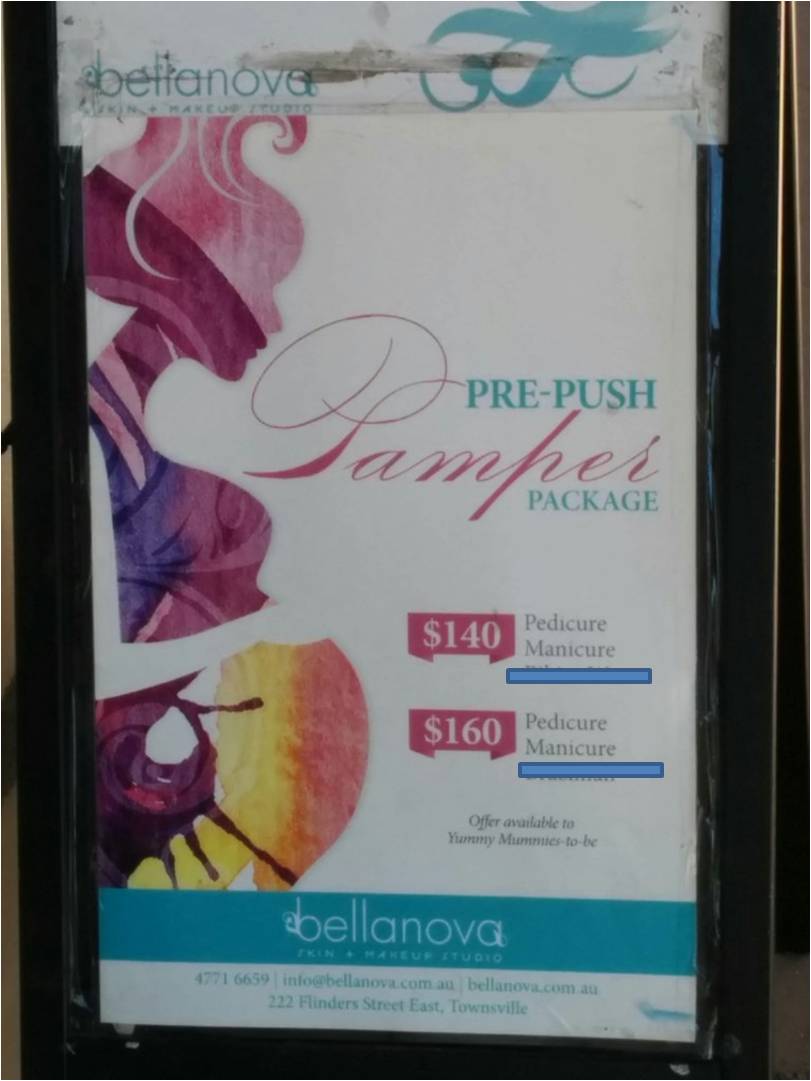
Branding and speaking techniques on a sandwich board


There it was. This sandwich board.

It caught my eye and then my imagination.

I had to go back and look again.

And what made it do that?

There are three reasons and they are all techniques we can use in our speaking and our branding to have people caught, intrigued and going back for another look (or listen).

1. She used Alliteration

All those Ps!

It's a beautiful rhetorical and literary device, alliteration, and it creates an effect called foregrounding

It creates a little hitch in the flow of attention, a little distraction. People might not even be aware that you used it, but they will be drawn to the words and their meaning. with a slight sense of intrigue.

If we count Pre-Push as one word, there is also anther device called the Rule of Three operating here. Create a list of three or a group of three and we have the same effect - that slight sense of interruption and something special.

2. She used Humour

(I'm using the word "she" because I met the owner of the establishment as I was taking a photo. She had a beautiful smile and very graciously and humbly accepted my exclamations about her marketing and my explanation that I wanted to use her work to share with you.)

I have never seen "Pre-push" used before.

Have you?

And even if you have, you have to admit it has flair.

It is a classic humour device - using the unexpected.

It made me smile and if we can make our audiences smile, we have them a little more open to feeling that we are likeable, that they can trust and believe our message.

3. She used an image

It's a subtle reinforcement, this image, of just what is meant by "Pre-push", and has a strong sense of the feminine, aimed, no doubt, at the target client, or perhaps her significant others.

We use images, too, to support our points when we speak. We don't need them to be distracting from our message, nor do we want them to be offensive.

(... and yes I have blocked out one of the words in the promotion in case you were offended or distracted by it!!)

So if you are in Townsville. Queensland, Australia and in need of some pampering, pre-push, I recommend you check out Bellanova.

And if you are in front of an audience, either presenting or online, I recommend you check out the lessons from her sandwich board, They are simple, subtle and powerful!!

one_message

One of the best pieces of advice any speaking coach can give is to create a message for your speech.

One central message.

Do not speak until you have one central message - one sentence - make it 140 characters if you're a tweep - but one sentence. Limit it to ten words if you want to really succeed.

If you were to condense your speech into one sentence what would that sentence be?

It forces us to really focus on our audiences.

Who are they? What do they really want? What is it that we really want to say to them? What is it that we really NEED to say to them?

Creating that one sentence forces us to simplify our speech structure. If there is only one message, then every single section, sentence and word needs to support that sentence. What doesn't work is jettisoned. How much easier does that make your choice of material and avoiding the temptation to ramble?!!

And when there is one single message in our presentation, then obviously there can only be one next step for the audience to take. If we give them too many options, they end up confused and take none. If there is just one next step for them, we are forced to present that in the most powerful, persuasive passionate way we can.

The problem, of course is that we would prefer to speak about a topic . "My passion is about TOPIC A," we think. "I'll speak about that - share my passion, get the audience enthused and inspired." If there is no message, though, we are left with the challenges of how to choose content, how to maintain the enthusiasm and inspiration, and, most importantly, no specific outcome for the audience, (or ourselves).

For many of us, too, there is the old belief that public speaking is all about showing just how knowledgeable we are - bombard the audience with heaps of important information and we have created an image of ourselves as .... worth knowing, worth hiring, worth whatever it is that we are desiring from this experience. And what does the audience get from the experience? Overload, confusion, maybe even boredom.

What do they remember? Possibly they remember one or two points - a story, perhaps or a word picture. And all that information was wasted. Unless we are incredibly good at creating a particular experience with the presentation, then it was wasted.

Having one single message, one single desired outcome, one single focus, would have made the limiting of the information overload so much easier.

And the process of creating this message?

I said at the beginning that this was one of the best pieces of advice that a speaking coach can give.

It's true.

It is not true, however, that the message must be formulated first.

Much as I would like to teach a single process to building a speech, it just doesn't work that way - well certainly not for me.

There is research about the topic, usually. There is a process of researching the audience. There is the collection and refinement of possible content. There are the thought processes that winnow and define the outcome required. They all respond to each other, careening and intertwining and sparking off each other. And out of all of those processes, finally comes a message.

Start with the topic by all means. But let the message develop.

It's a difficult process, but one of the most rewarding!

beauty_data

Images are becoming the new language of content communication.

As David McCandless says ... "We are being blasted every day, all of us are being blasted by information design. It's being poured into our eyes by the web and we're all visualisers now, we're all demanding a visual aspect to our information and there's something magical about visual information."

The fact that "a picture paints a thousand words" is now mainstream.

As speakers, we use them in our social media. We use them in our blogs. We use them in our presentations.

"By visualizing information, we turn it into a landscape that you can explore with your eyes, a sort of information map. And when you’re lost in information, an information map is kind of useful." says David McCandless.

If you've watched this TED talk than you will know ... if not, then watch right now, and know ... that David McCandless inspires with his presentation style, and his amazing ways of designing infographics.

Be reminded of, and inspired by, the possibilities for you as a presenter, and renew your enthusiasm for creating graphics that will allow your audiences, the visitors to your websites and your social media peeps to understand that you have the power to create meaning for them.

Does size matter in public speaking

It's an age-old argument ... that bigger is better.

And without getting into too much anatomical detail or economic theory, sometimes it is.

Does that mean more is better too?

Well when it comes to speaking, the belief that more is better has been many a speaker's downfall ... including my own!

For me, I think it comes from the old school idea that more information means a higher mark, and possibly the old-school culture of an information age where information was king and prized above rubies.

It also comes, I think, from a need to come from a place of power as a speaker - a place of asserting authority on a subject, of being seen as the expert.

There's an old speaking proverb that says "When you squeeze your information in, you squeeze your audience out."

In order to create power for ourselves, we inadvertently take away power from the audience.

Some of the best speaking engagements I have had, have been where I was able to ask the audience questions - and get answers. Sometimes the groups were small enough to have an actual conversation, sometimes there were large so that I had to have show of hands or some other type of response. But I sensed the feeling of validation in the people who responded and in those around them. And we learnt from each other, sometimes far more than they simply would have learned from me.

There is value in giving power to our audiences.

There is value in not squeezing them out with an overload of information, too.

We want to be remembered. What is it that we want to be remembered for?

We want an outcome, a next step, for our audiences to take. What is that one step?

How many things do you remember from the last presentation you attended? One? Maybe three?

How many next steps can we realistically expect an audience to take when we finish speaking, or in the days, weeks, months afterwards? One? Any more than one?

So there is value then, in giving only the information that will contribute to that single powerful memory or that single next step. Give too much information , more than anyone could be expected to remember, or act upon, and we give nothing more than confusion, a garbled message. The result - forgettable and ineffective.

In this age driven by quick visuals and 140-character messages, there is enormous power is presenting a very focused, very memorable single message or two. You will be invited back, and/or you will have built a bridge to further communication and then can share more.

We can still be seen to be giving valuable loads of information, but remember at the same time that one single focus, that one memorable message.

Can you, as Carmine Gallo has challenged his students, write your message in 140 characters?

Bigger is not always better.

More is not always better.

And for speakers, less is definitely more.

Cleaning out my inbox I discovered this graphic in an email from the beginning of last year.

Do you live in the UK or US?

Does this ring true? ...

and ...

does it matter?

Your opinion in the comments may just mean the difference between success and failure for an international speaker!!

T-M-Lewin-Infographic_600px
This infographic is supplied by T. M. Lewin

We are incredibly blessed to have an environmental park just 50 metres from our home. I am grateful to old George Swanston, our local Council representative more than twenty years ago, who fought to have it gazetted as such, and not given over to developers. We now have a backdrop of trees from our house and access to beautiful walking tracks and scenery.

At our particular entrance to the park is a disused quarry - huge sandstone cliffs where blocks of stone were removed. It has been shored up, but part of it remains rather unstable and in times of heavy rain, boulders are sometimes dislodged. It is now a beautiful, serene place.

The piece of landscape I focussed on this morning, though, had me thinking ...

quarry_ps

This is the wall the park-keepers have created to protect the walking path from falling boulders.

And it reminded me of constructing a speech (possibly because I'm currently putting together a workshop on the subject!)

See the wire netting they have used to make sure the stone wall stays in place?

Sometimes I feel like I am in need of such a cage - something to keep the whole speech together and tight and effective - not allowing ideas to escape out of the structure I want.

We collect such a miscellany of thoughts, and knowledge and experiences and opinions and do our best with them. We sort them and discard those that will not support the message we want for this particular audience. We build them into a structure that will work for this presentation. It will be strong. It will work to make the message flow and shape so that the audience follows it easily without too much awareness of its existence. It will look and feel good to ourselves as we present, giving us confidence in the whole.

And that's what they have done with these stones in this wall. They collected a huge number, and sorted out the ones that will fit and that are of a similar size so that they can be stacked into a shape. They built them into a structure that will protect the walkers here on the path, without intruding into the flow of their walk or run. And I suspect they are rather proud of their final construction.

And yet ...

They had to put the net around it. Was it not built well enough?

Perhaps they did not have a proper dry-stone wall person. Perhaps it is not finished and they intend to replace it or cover it with concrete or such.

The question remains ... though I am so happy people are taking care of the park and making it safe.

And yet...

These grey stones are not native to the area - well not in evidence anywhere around. They are imports. The whole structure seems alien.

Did you ever feel that about a speech?

Maybe it didn't align with your passions. Maybe you were presenting someone else's material. Maybe you've seen a speaker who had found the audience was not as they expected, or the speech just didn't belong in the event, either subject-wise, or energy-wise.

Still I am grateful.

Returning from my walk, I follow the little side street and in front of me, at the end of the street, is this beautiful tree.

jacaranda

It belongs (though it was planted there).

It has its own natural shape. Nothing constrains it (though it was pruned - many years ago).

It is beautiful.

Is this what it feels to present a speech so that it feels like it belongs, so that it feels natural, unconstrained, and we can feel its beauty?

The speaker's own energy and authentic passion,

constructed for this audience and their needs and wants and values,

suitable to the event, aligned with its intent and vibe.

I wish you (and me) many more trees ... and many more speeches that give as much pleasure and satisfaction.

The Public Speaking Power in Creating

Public Speaking is all about you, isn't it?

You the speaker.

You creating a speech.

You delivering a speech.

You taking the audience on a journey.

You affecting the outcome.

You presenting stories, humour, information, ideas, products.

Me, the speaker.

Me, facing my fears.

Me, being confident.

Me, remembering the best words to use.

Me, creating energy in the room.

Me, finally achieving success as a speaker.

This blog is aimed at You (and if you are reading this, then it is about "me").

I am writing and speaking to you, hoping to give you ideas and resources that will be of value to you as a speaker.

Strange, then, that the one sure foundation of success is the ability, once the presentation begins (or even in the marketing beforehand) to make it about us - all of us in the room, all of us on this journey to being better, living better, being and living more easily.

Not just the audience - the "you" to whom we speak - else we become preachers, philosophers, at least one step, if not a whole staircase removed, from that audience, that "you".

We are all on this journey together, supporting each other.

How can we best ensure that, in our blogs, in our social media, in our speaking?